

The evolution of the Innovation Lab
Inaugurated in 2023, the Innovation Lab embodies Gaznat’s commitment to rethinking the energy concept at its Aigle site while creating a platform dedicated to industrial testing of new energy-related technologies.
Following the success of the GreenGas project, which won the 2026 Watt d’Or award, Gaznat’s Research and Development (R&D) platform continues to expand. In the summer of 2025, the Innovation Lab, in collaboration with EPFL, hosted the SWITCH system, a reversible fuel cell capable of operating in both “Power to Gas” and “Gas to Power” modes.
SWITCH stands for “Smart Ways for In-Situ Totally Integrated and Continuous Multisource Generation of Hydrogen.” SWITCH was originally a European project under the “Horizon 2020” program that aimed to design, build, and test a prototype of an innovative hydrogen production system based on SOFC (Solid Oxide Fuel Cell) technology. Currently being installed at the Gaznat site, this equipment is being developed jointly by SolydEra and HyGear, two companies specializing in energy technologies and hydrogen management.
Toward low-carbon hydrogen
The SWITCH system is a stationary, modular, and continuous multi-source hydrogen production technology designed for hydrogen refueling stations (HRS).
At the heart of the system is a reversible Solid Oxide Cell (rSOC) that operates in two modes:
The integration of these two modes enables continuous, decentralized, and guaranteed production of hydrogen and electricity for end users.
This bidirectional setup is particularly valuable in the context of grid convergence. The Innovation Lab thus provides a unique environment for testing, validating, and, ultimately, integrating these innovations into existing infrastructure to decarbonize operations across the entire natural gas sector.
The SWITCH system has four main objectives:
1. Efficiency : to increase the efficiency of hydrogen supply through multi-source production that optimizes green hydrogen production capacity while minimizing electricity costs.
2. Sustainability : improve the sustainability of the hydrogen supply by aiming for a 65% reduction in CO2 emissions during hydrogen production compared to conventional methane reforming.
3. Cost reduction : reduce the cost of the hydrogen supply by targeting a cost of €5/kg H for a production rate of 40 metric tons of hydrogen per day (SOE/SOFC operations).
4. Flexibility : increase the flexibility of hydrogen production by utilizing multiple feedstock sources and “switching” between the two operating modes.
The tests planned with the SWITCH system in Aigle focus primarily on three areas:
Durability
Conduct long-term tests to assess degradation and performance of the stack4 and the module across different production modes.
Reliability
Improve and validate the controllability of the modules during transient phases and operating modes to ensure better integration of the system into industrial environments.
scaling-up
a. Assess the ability to integrate with storage solutions, methanation, and other hydrogen-related technologies.
b. Test new generations of more efficient electrolysers.
4The heart of the electrolyser
SWITCH SYSTEM MODULES
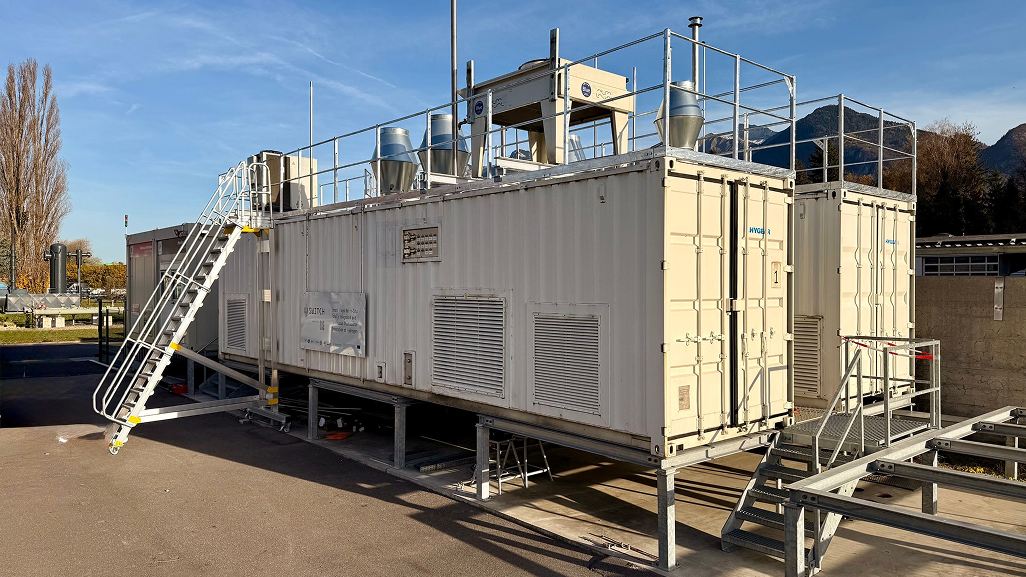
The SWITCH system consists of two 40-foot (12-meter) “high cube” containers, assembled by HyGear in Arnhem, the Netherlands, each performing a specific function:
- The first container is dedicated to gas compression and purification using the PSA (pressure swing adsorption) process, ensuring high-purity gas.
- The second container is dedicated to the production of electricity and hydrogen. It can accommodate up to two reversible SOC modules, capable of both generating electricity from hydrogen and producing hydrogen from electricity.
CALL FOR PROJECTS UNDER THE GAZNAT-EPFL RESEARCH PROGRAM
Innovation is a major strategic focus for Gaznat. Beyond its Innovation Lab platform, the company is actively invested in basic and applied research to foster the emergence of new technologies, new products, and new protocols. These initiatives aim to enable the gas industry to effectively support the energy transition.
In December 2024, EPFL and Gaznat signed a new seven-year framework research agreement with a total budget of five million francs.
A joint scientific committee, with one member representing EPFL and the other representing Gaznat, evaluates and selects the submitted projects. It consists of four members from EPFL and four members from Gaznat.
This partnership calls for three calls for proposals between 2025 and 2027.
The first call took place in the summer of 2025, during which 33 proposals were submitted, demonstrating strong interest in this scientific initiative. Following the selection process, seven projects were chosen. They focus on new CO2 capture technologies, electrolysers, and new processes for producing biomethane.
This collaboration with EPFL positions Gaznat as a major player in innovation within the gas industry, particularly in the fields of synthetic gas and hydrogen production, carbon capture and storage, and the optimized management of a high-performance high-pressure transmission network, both in terms of infrastructure and operations, with the support of artificial intelligence.
Gaznat therefore intends to continue and strengthen its momentum in cutting-edge innovation, in close collaboration with academia and startups. The next call for projects is scheduled for the summer of 2026.