

TRADING
Overview of Swiss Consumption
Natural gas consumption in Switzerland fell by -1.1% compared to 2024, reaching 31.1 TWh in 2025.
Natural gas consumption in Switzerland,
2006–2025 (in TWh)
Sales Down in the Gaznat Area
The average temperature in Switzerland for 2025 was 1.2°C above the average calculated from 1991 to 2020, but 0.2°C below that of 2024. In the area covered by Gaznat, annual heating degree-days (HDD 20/12)5 were 5.5% higher in 2025 compared to 2024.
The total volume of natural gas delivered to Gaznat customers in the Gaznat service area was 8.9 TWh in 2025, down 1.3% from 2024. However, after adjusting for weather-related factors, the volume of natural gas sold in the Gaznat service area decreased by 5.1%.
The total volume of natural gas sold by Gaznat amounted to 9.1 TWh in 2025, down 1.4% compared to 2024. In contrast, sales to Swiss non-shareholder customers rose by 7.8%.
Gaznat Sales,
2006-2025 (in twh)
Overall, the spot6 market for THE was generally bearish in 2025. Prices fell from €50/MWh at the end of 2024 to €30/MWh at the end of 2025. Buyers benefited from an abundant supply of LNG following the commissioning of new liquefaction terminals, particularly in the United States, and from declining demand in Asia.
520/12 heating degree days: when the average daily outdoor temperature is below 12°C, the 20/12 heating degree days are calculated as the difference between 20°C and that temperature.
6Spot price: price for next-day delivery in bulk
Security of Supply
The war in Ukraine since 2022, and the near-complete cessation of Russian gas deliveries to Western Europe, have further reinforced the importance Gaznat places on security of supply. Since the beginning of the fourth quarter of 2024, Gaznat has had three contracts with reliable suppliers for delivery to French, German, and Italian hubs. However, the flexibility of these contracts regarding the volumes to be taken leaves ample room for spot and forward purchases on the market (56% in 2025).
As mandated by the Federal Council via ordinance, Gaznat has stored in France 15% of the average annual consumption of the area served by its high-pressure network. Access to gas stored in France is protected by an intergovernmental agreement dating from 2009, which grants Gaznat the same priority access to stored gas in the event of a shortage as distributors in eastern France.
NETWORK
Modernization of the Vernier Pressure Reduction and Metering Station (PDC)
The Vernier Pressure Reduction and Metering Station (PDC) is one of the largest in the Gaznat network. This facility, owned by Services Industriels de Genève (SIG), has undergone a complete upgrade.
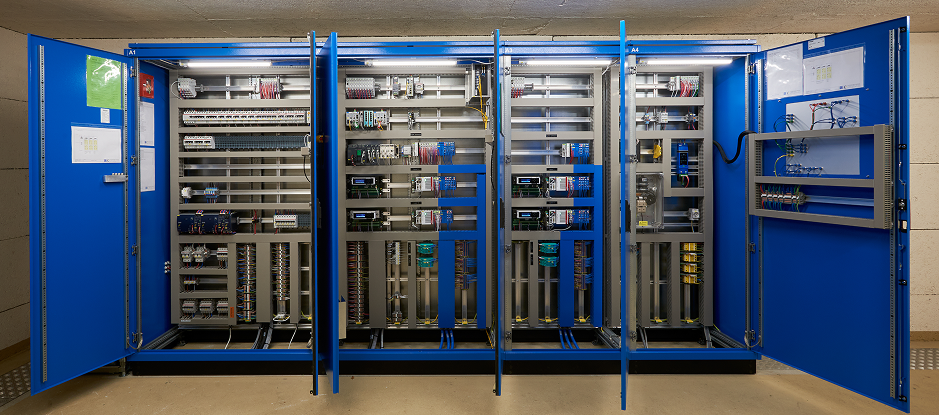
The site is now equipped with new electrical panels that control the various regulatory components. Thanks to state-of-the-art technology, SIG can now operate the station more efficiently, particularly with regard to managing the fill levels of the storage sphere.
The collaboration among all parties involved - SIG, heating contractors, and both in-house and external electrical teams - was exemplary. As a result, the facility was delivered on schedule and ready for operation.
Replacement of Electrical Panels at the La Cure Customs Station
The La Cure customs station is a vital link in Gaznat’s network. Equipped with electrical panels over twenty years old, its control system required extensive modernization. The main challenge for the Gaznat teams was to carry out this work while ensuring the continuity of supply provided by this strategic station.
At the conclusion of the project, a major control valve was also replaced to resolve a technical issue affecting that equipment. Feedback on this new system has been particularly positive, resulting in a significant reduction in noise pollution around the site.
Measured power and volumes transported
The stabilization in the volume of gas transported observed in 2024, following two years of significant decline, continued into 2025, with 10,518 GWh transported (compared to 10,580 GWh in 2024). During fiscal year 2025, the measured power on the network reached 3,498 MW, representing a 6% increase compared to 2024.
MEASURED CAPACITY AND VOLUMES TRANSPORTED 2006-2025

Grid Infrastructure Safety
The safety of people and property is Gaznat’s top priority:
- On its network, 135 permits for third-party work were issued by the Federal Pipeline Inspectorate (IFP), roughly the same number as the previous year (136 in 2024).
- Weekly infrastructure monitoring, conducted both on the ground and by helicopter, identified and halted 12 third-party construction projects that had begun without prior authorization (compared to nine in 2024). To enhance safety and provide additional mechanical protection, 908 meters of protective slabs were installed during the year over high-pressure pipelines (compared to 172 meters in 2024).
PERMITS FOR THIRD-PARTY CONSTRUCTION WORK NEAR GAS FACILITIES, BY CANTON (2025)
MAINTENANCE
Data on High-Pressure Network Operations in 2025
• 908 meters of protective slabs installed
• 12 unauthorized third-party projects halted thanks to helicopter surveillance
• No transmission capacity restrictions
• No supply interruptions.
QUALITY - SAFETY - ENVIRONMENT
ACCIDENTS
• Sixteen non-work-related accidents were reported, only three of which resulted in lost-time absences.
• These results confirm the performance observed in 2024 and are in line with the industry average.
Staff Training
Employee training hours totalled approximately 1,130 hours in 2025, of which 551 hours were dedicated to safety.
Crisis Management
In 2025, all managers took a refresher course on the crisis management method implemented in 2023. In addition, a new crisis management exercise was conducted, simulating a physical intrusion into the facilities. Members of the crisis response team were brought together to manage this event, guided by external experts in the field. The results of this exercise were entirely satisfactory in terms of the crisis response team’s readiness and the training level of its members.
Environment
No environmental issues of concern were reported in 2025 regarding the operation of Gaznat’s gas infrastructure. A new generation of control valves for the gas network is currently being tested, with plans for widespread implementation if the results prove conclusive.
Its design significantly reduces gas losses during the operation and maintenance of gas facilities. Additionally, the control and monitoring center was equipped with nine electric vehicle charging stations.
FINANCE AND SERVICES
FINANCE
Gaznat SA’s revenue continued to normalize in 2025, after reaching a record high of CHF 2.2 billion in 2022. It thus fell back below the symbolic threshold of one billion francs, settling at CHF 885 million - a 32% decrease compared to the previous year. This decline is primarily attributable to lower gas prices on European markets, as sales volumes remained virtually stable year-over-year at 8.9 TWh (-1.3%).
turnover in mchf
This high volatility in revenue has no impact on the company’s financial performance, which remains solid and even shows a significant increase compared to the previous year, with net income of CHF 27.2 million. Excluding exceptional financial gains from dividends (in 2024) and the sale (in 2025) of the Swiss Energy Trading subsidiary, operating performance (EBIT) increased by 2% compared to 2024.
Net profit in
million CHF
With the European gas market having become more predictable and less volatile, management seized the opportunity presented by the maturity of its syndicated operating loan in December 2024 to refinance it under more favorable terms, for a total of CHF 170 million. This new credit line will be used, on the one hand, to finance gas and power purchases for its customers, and on the other hand, to invest in biomethane production assets in Europe.
With the decline in gas prices on the markets in 2025, working capital loans were drawn upon less frequently, which helped limit financial expenses. At the end of 2025, the Group’s average borrowing rate stood at an attractive 2.01%, and the average maturity of its debt decreased to two years.
Gaznat SA’s balance sheet structure remains very solid, with a consolidated equity ratio of 37% and a decline in net debt to CHF 79 million, down from CHF 119 million at the end of 2024, against total assets of CHF 431 million.
MATURITY AND AVERAGE DEBT RATIO
Information Technology (IT)
In addition to managing security, developing the technology infrastructure, and supporting business and digital transformation projects, the IT team has focused its efforts on the company’s cyber resilience. With the support of external experts, the team continued its work to ensure that, by mid-2027, governance, internal systems, and procedures are fully compliant with the ICT (Information and Communication Technologies) standard for Gas Supply 2.0. Several modules were finalized in 2025, including cyber risk analysis, an inventory of critical assets, third-party vendor management, and the implementation of a ticketing system to track and log incidents.
COMMUNICATION
Modernization of external and internal communication platforms
The year 2025 was marked by a commitment to accelerate the company’s modernization and digital transformation efforts. The new website (www.gaznat.ch) was launched in June 2025, during the 57th Annual General Meeting. It was thoroughly redesigned with the goal of offering users a more seamless, intuitive, and accessible experience. Built around the goal of informing the general public about the important role of natural gas in the energy transition, it also highlights technological innovation projects in partnership with EPFL, the diversity of roles within the company, and the expertise of its teams.
In December 2025, it was the company’s intranet’s turn to undergo a complete overhaul. The new site was presented to employees during the traditional end-of-year meeting. Designed as a true internal digital platform for sharing resources and content, the new intranet serves as a key tool for rolling out the employer branding strategy, which is currently under development.
It will help strengthen the corporate culture and team engagement, while providing employees with easier access to company news and standard operating procedures.